Table of Contents
- Introduction
- The Shifting Landscape of Global Tool Manufacturing
- India’s Rise as a Premier Tool Manufacturer
- Key Product Categories: Sockets, Chisels, Sandpaper & More
- How Indian Socket Sets & Wrench Sockets Compare to Germany Tools
- Cost Efficiency Without Compromising Quality
- Certifications & Standards That German Buyers Demand
- Building Supply Chain Resilience Beyond Knipex and Gedore
- What German Importers Should Look for in an Indian Tool Manufacturer
- FAQs
- Conclusion
1. Introduction
For decades, Germany has been synonymous with world-class tooling. Brands like Knipex, Wera, Gedore, and Felo have set the gold standard — from the iconic Joker Wera adjustable wrenches and Gedore Drehmomentschlüssel (torque wrenches) to the precision of Knipex Abisolierzange (wire strippers) and Knipex Rohrzange (pipe wrenches). Germany tools have long been the benchmark against which all others are measured.
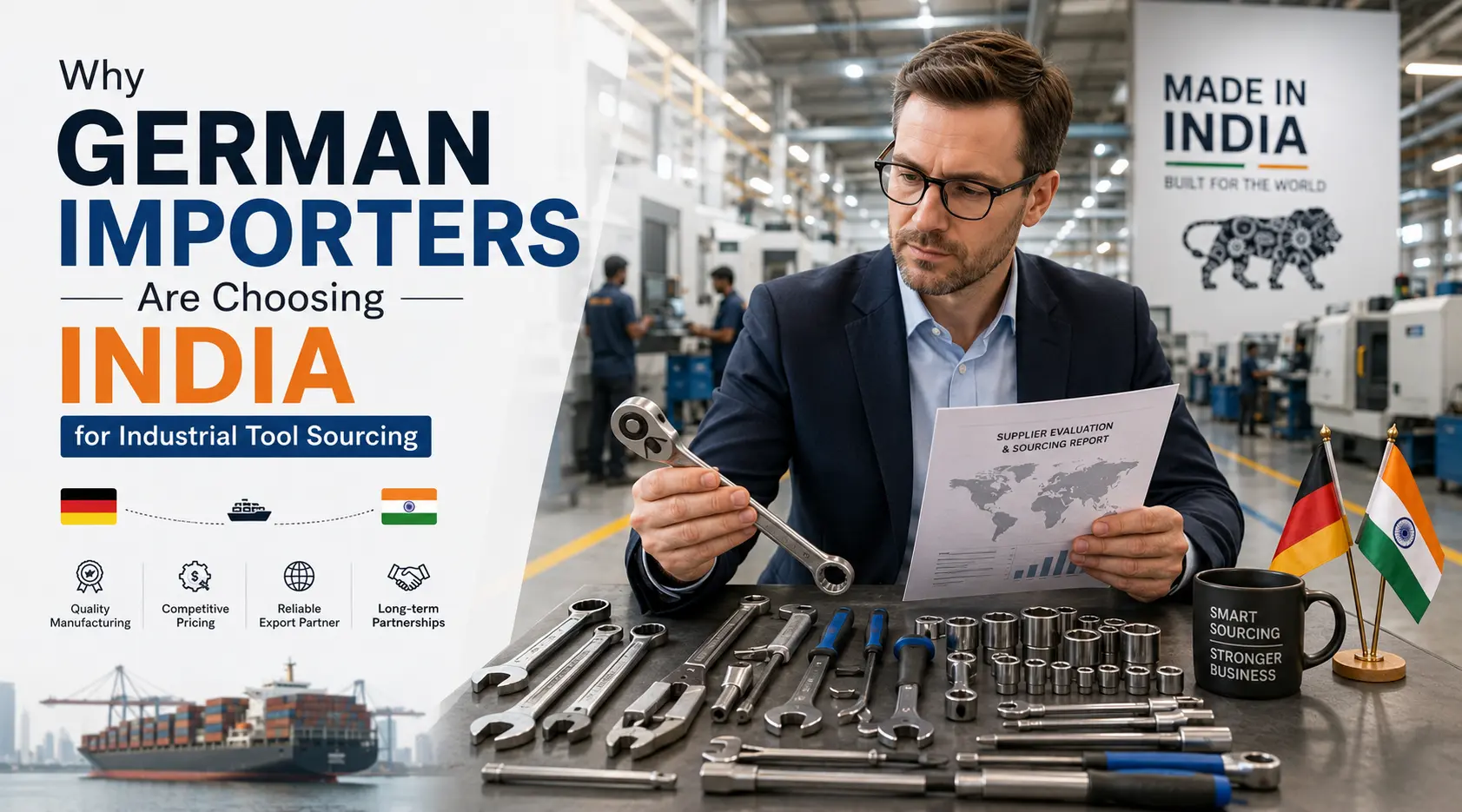
But something significant is happening in global procurement circles. German importers — from mid-sized Werkzeug distributors to large industrial buyers — are increasingly turning their attention eastward, specifically toward India, for cost-effective, high-quality industrial tool sourcing. This isn’t a compromise on quality. It’s a calculated strategic shift driven by economics, manufacturing maturity, and supply chain diversification.
This blog post explores the “why” behind this growing trend, what product categories are being sourced, how Indian manufacturers stack up against the legacy of germany tools, and what importers should look for when building a supplier relationship.
2. The Shifting Landscape of Global Tool Manufacturing
The global hand tools and power tool accessories market was valued at over USD 28 billion in 2023 and continues to grow steadily. Historically, Germany, the United States, and later China dominated this space. However, rising labor costs in China, geopolitical uncertainties, and quality inconsistency have prompted European buyers — particularly German importers — to diversify their sourcing strategies.
India has emerged as a natural alternative. With a well-established manufacturing base, a large and skilled workforce, and a growing number of ISO-certified facilities, India offers a compelling proposition for categories ranging from sockets and socket sets to chisels, sandpaper, shifting spanners, and wrench sockets.
India’s engineering goods exports have been growing at nearly 8–10% annually, and hand tool exports specifically have seen double-digit growth in markets like Germany, the Netherlands, and the broader EU. The message is clear: Indian tool manufacturing has come of age.
3. India’s Rise as a Premier Tool Manufacturer
India’s tool manufacturing hubs — primarily in Jalandhar (Punjab), Nagaur (Rajasthan), Aurangabad (Maharashtra), and parts of Gujarat — have undergone a transformation over the past 15 years. What were once small-scale forging units have evolved into sophisticated manufacturing facilities capable of producing precision tools that meet European norms.
Several factors underpin this rise:
Raw Material Availability: India has abundant access to high-grade alloy steels like Chrome Vanadium (CrV) and Chrome Molybdenum (CrMo), the same materials used in premium germany tools for producing durable wrench sockets, shifting spanners, and socket sets.
Skilled Engineering Workforce: India produces over 1.5 million engineering graduates annually. This talent pool feeds directly into R&D, quality control, and precision manufacturing.
Export-Oriented Policies: Government schemes like the Production Linked Incentive (PLI) for engineering goods have accelerated capacity expansion and technology upgrades among Indian tool manufacturers.
Competitive Pricing: Despite quality improvements, Indian manufacturers maintain a significant cost advantage — often 30–50% lower than equivalent European-made products.
4. Key Product Categories: Sockets, Chisels, Sandpaper & More
German importers are sourcing a wide variety of tools from India. Here’s a closer look at the most popular categories:
Sockets and Socket Sets
Indian manufacturers produce a full range of sockets — from 1/4″ drive to 3/4″ drive — in both metric and imperial standards. Socket sets with 72-tooth ratchets, extension bars, and universal joints are among the most exported products to Europe. These are manufactured from CrV steel with mirror-polished or satin finishes and heat-treated for durability.
Wrench Sockets and Shifting Spanner
Wrench sockets in deep and standard profiles, along with shifting spanners (adjustable wrenches), are produced by multiple Indian manufacturers certified to DIN and ISO standards. These directly compete with mid-tier European equivalents.
Chisels
Forged chisels — wood chisels, cold chisels, and masonry chisels — are another strong export category. Indian manufacturers use carbon steel and alloy steel, with proper hardening and tempering processes to ensure edge retention.
Sandpaper and Abrasives
India is one of the largest producers of coated abrasives globally. Sandpaper in aluminium oxide, silicon carbide, and zirconia grades is exported in massive volumes to Germany for woodworking, metalworking, and automotive finishing applications.
Specialty Tools
Items like Phillips head screws compatible with Pozidriv and Phillips driver sets, cabinet keys (Schaltschrankschlüssel), hex keys (Stiftschlüssel), and cable cutters (Kabelschere) are all being successfully sourced from Indian suppliers.
5. How Indian Socket Sets & Wrench Sockets Compare to Germany Tools
This is the question every German importer asks: can Indian tools really stand alongside werkzeuge Gedore, Felo screwdrivers, or the legendary Knipex Rohrzange?
The honest answer: for many product categories, yes — and for some, not quite yet.
| Feature | Premium Germany Tools (Knipex, Gedore, Wera) | Indian Manufacturer Tools |
| Material Grade | CrV, CrMo, Special Alloys | CrV, CrMo (standard grades) |
| Tolerance Precision | ±0.01 mm | ±0.02–0.05 mm |
| Finish Quality | Mirror / Satin | Mirror / Matt (varies) |
| Certification | DIN, VDE, ISO | ISO, BIS, some DIN |
| Price Point | High (premium segment) | Low to mid-range |
| Lead Time | 4–8 weeks | 6–10 weeks |
| MOQ Flexibility | Low | Medium to High |
The gap is narrowing rapidly. Indian manufacturers have invested heavily in CNC machining centers, heat treatment furnaces, and CMM (Coordinate Measuring Machine) quality control. For volume-driven commercial applications — construction, automotive assembly, general maintenance — Indian-sourced socket sets, chisels, and wrench sockets perform comparably to European mid-tier offerings at a fraction of the cost.
6. Cost Efficiency Without Compromising Quality
The economics are hard to ignore. A set of 40-piece socket sets from a German brand can retail at €80–€150 in the German market. A comparable Indian-manufactured set can be sourced at €15–€25 landed cost, leaving substantial margin for distributors or end-users.
For sandpaper and abrasives, Indian suppliers offer significant savings on bulk rolls and sheets. For chisels in construction-grade categories, Indian forged tools priced 40–60% lower than German equivalents are increasingly accepted by professional users.
This doesn’t mean buyers compromise on safety or reliability. The key is selecting the right manufacturer — one that invests in quality systems and understands German market requirements.
7. Certifications & Standards That German Buyers Demand
German importers operate in a strictly regulated market. Any tool entering Germany must comply with relevant EU directives and, ideally, carry recognized certifications. Here’s what to look for:
- ISO 9001:2015 – Quality Management System certification is a baseline requirement.
- DIN Standards – Tools like Gedore Drehmomentschlüssel-grade torque wrenches should conform to DIN EN ISO 6789.
- CE Marking – Required for many power tool accessories and cutting tools entering the EU market.
- VDE Approval – For insulated tools like those used in Kabelschere (cable scissors) applications, VDE approval (tested to 1000V) is essential.
- REACH & RoHS Compliance – Chemical safety compliance is non-negotiable for EU importers.
Leading Indian tool manufacturers operating in the export segment are well aware of these requirements and maintain necessary certifications. Always verify certification documents before finalizing suppliers.
8. Building Supply Chain Resilience Beyond Knipex and Gedore
The COVID-19 pandemic and subsequent supply chain disruptions taught German importers a painful lesson: over-reliance on a single geography — or even a single brand — creates dangerous vulnerability. While Knipex Abisolierzange, Joker Wera tools, Schaltschrankschlüssel Knipex, and Stiftschlüssel sets from established brands remain irreplaceable for premium-tier customers, mid-tier and private-label markets need alternatives.
Indian sourcing offers:
- Dual-sourcing capability – Reduces risk by providing a backup supply chain parallel to European suppliers.
- Private label flexibility – Many Indian manufacturers produce OEM tools under buyer-specified branding.
- Scalability – Indian manufacturers can ramp production volumes far faster than boutique European makers.
- Customization – From packaging in German to product labeling compliant with EU regulations, Indian exporters are experienced in meeting European buyer requirements.
9. What German Importers Should Look for in an Indian Tool Manufacturer
Not all Indian manufacturers are equal. Here’s a practical checklist for German buyers:
- Factory Audit Ready – The supplier should welcome third-party audits and have no hesitation sharing their facility, processes, and certifications.
- Material Test Reports (MTRs) – Always request steel grade certification and hardness test reports.
- Sample Orders First – Never commit to bulk orders without extensive sample testing.
- Export Experience – Prioritize manufacturers with proven EU export history; they understand documentation, packaging, and compliance.
- R&D and Engineering Capability – For custom socket sets or specialty wrench sockets, ensure the supplier has in-house design capability.
- Communication Standards – For German buyers, clear and prompt communication in English (and ideally German) is a significant plus.
- Minimum Order Quantities – Understand MOQ structures upfront to align with your inventory strategy.
10. FAQs
Q1: Are Indian-manufactured sockets and socket sets suitable for professional use in Germany? Yes, for many commercial and industrial applications. Tools manufactured to ISO and DIN standards from leading Indian exporters are widely used in automotive, construction, and general maintenance sectors across Europe. However, for precision torque applications requiring DIN EN ISO 6789 compliance — similar to Gedore Drehmomentschlüssel torque wrenches — buyers should verify specific certifications.
Q2: Can Indian manufacturers replicate the quality of tools like Knipex Rohrzange or Felo screwdrivers? Indian manufacturers produce tools that are competitive in the mid-tier segment. While replicating the premium finish and microscopic tolerances of brands like Knipex Rohrzange or Felo is still a challenge, the quality gap is closing. For volume commercial applications, Indian alternatives offer excellent value.
Q3: What is the typical lead time when sourcing tools from India? Lead times vary by product and manufacturer, but generally range from 6–12 weeks for standard orders. Custom products like specialty stiftschlüssel (hex keys) or branded socket sets may take 10–14 weeks including tooling and sampling.
Q4: How do I verify the quality of a new Indian tool supplier? Request material test reports, ISO certificates, and sample orders. Consider engaging a third-party inspection agency based in India (such as SGS, Bureau Veritas, or TÜV SÜD India) to conduct pre-shipment inspections and factory audits.
Q5: Are Indian manufacturers familiar with German labeling and packaging requirements? Experienced Indian export manufacturers are well-versed in EU packaging norms, including German-language labeling, REACH compliance documentation, and GS mark requirements. Always specify requirements clearly in your purchase agreement.
Q6: Can Indian suppliers produce VDE-certified insulated tools like Kabelschere? Some Indian manufacturers do produce VDE-certified insulated tools, including cable cutters (Kabelschere) rated to 1000V. However, the number of such certified suppliers is limited — careful vetting is essential.
Q7: Is sourcing from India cost-effective even after shipping and import duties? In most categories — sandpaper, chisels, wrench sockets, socket sets, and shifting spanners — the landed cost including freight and applicable EU import duties remains 25–45% lower than comparable European-manufactured products, making India a highly attractive source.
11. Conclusion
The trend of German importers turning to India for industrial tool sourcing is not a passing phase — it is a structural shift in global supply chains. As Indian manufacturers continue to invest in quality systems, certifications, and export infrastructure, the proposition only gets stronger.
While the legendary status of Joker Wera, Werkzeuge Gedore, Knipex Abisolierzange, Felo, and other iconic German tool brands remains unchallenged at the premium end, the vast middle and commercial-grade market has a new, credible player. Indian-manufactured sockets, socket sets, wrench sockets, shifting spanners, chisels, sandpaper, stiftschlüssel, schaltschrankschlüssel, and kabelschere tools are meeting global standards and delivering measurable value to German importers.
For importers looking to diversify supply chains, reduce costs without sacrificing quality, and build resilience into their tool sourcing strategies, India deserves serious consideration. The key lies in due diligence — choosing the right manufacturing partner, verifying certifications, and establishing clear quality expectations from the start.
India is no longer just an emerging option. For a growing number of German importers, it is already a proven one.
For sourcing inquiries, factory audit support, or trade introductions to certified Indian tool manufacturers, connect with your regional export promotion council or industry trade body specializing in engineering goods.
Read More: What Are the Cost Differences When Sourcing Hand Tools from China Versus India?