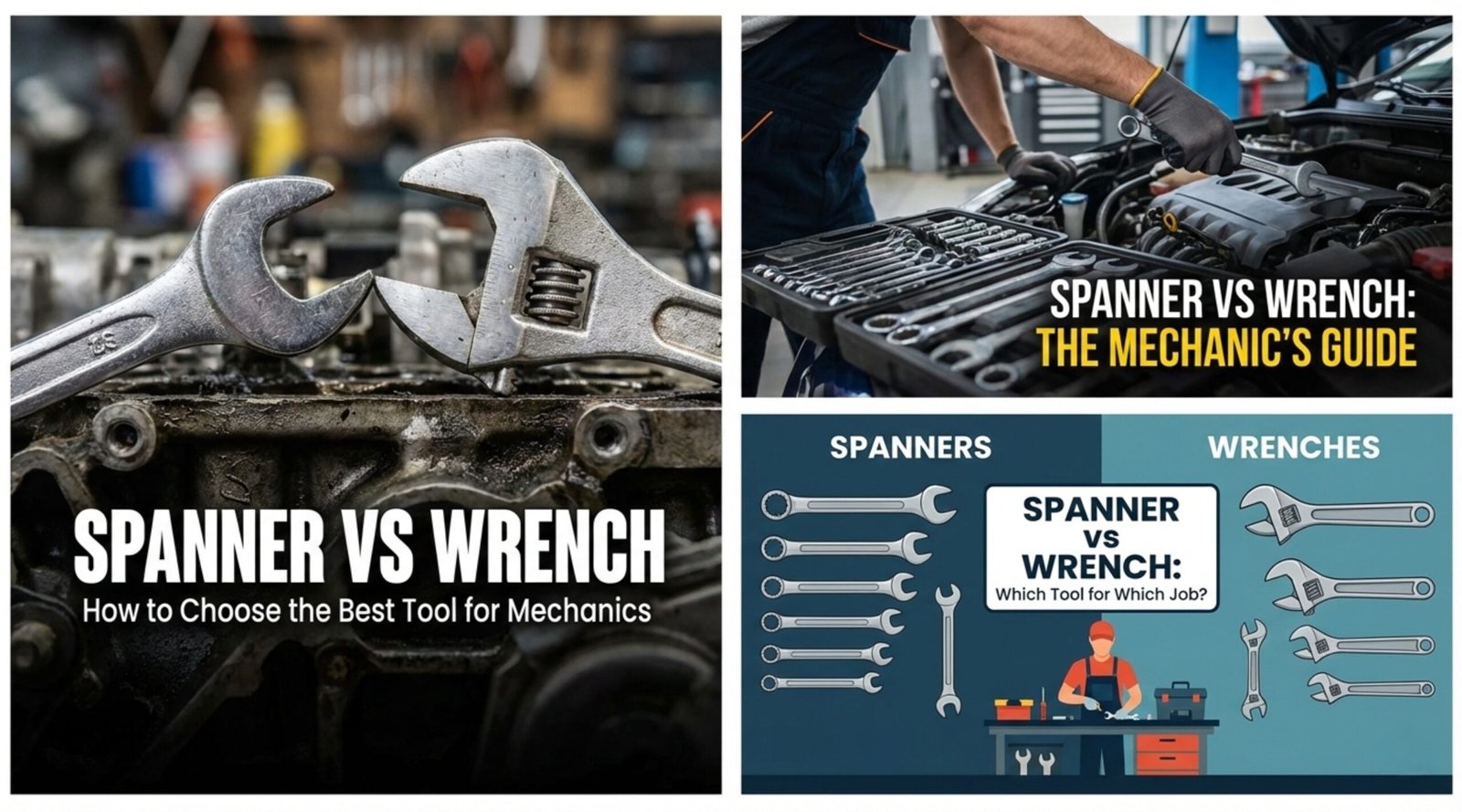
Hand tools are the backbone of mechanical work, whether it is routine vehicle maintenance, industrial assembly, or heavy-duty repair jobs. Among all hand tools, the spanner wrench holds a critical place. Yet, one common question continues to create confusion across regions and industries: What is the difference between a spanner and a wrench? And more importantly, how do mechanics choose the right tool for their specific needs?
This article offers a clear, practical explanation of spanner vs wrench, breaks down different spanner types, explains real-world spanner uses, and helps professionals select the most suitable tool based on application, size, torque, and working environment.
What Is a Spanner? Understanding the Spanner Meaning
A spanner tool is a hand tool designed to grip, tighten, or loosen nuts and bolts. In many parts of the world, especially the UK, India, Australia, and several Asian and African markets, the term spanner is commonly used.
From a functional point of view, the spanner meaning is simple: it is a tool that applies controlled torque to fasteners without damaging their edges. Spanners are engineered to fit specific nut or bolt sizes, ensuring precision, safety, and efficiency.
In professional workshops, spanners are considered essential because they provide:
- Better grip on fasteners
- Reduced risk of rounding edges
- Consistent torque application
- Long-term durability for repetitive use
What Is a Wrench? Why the Term Is Used Differently
The term wrench is more commonly used in the United States, the Middle East, and international trade documentation. Functionally, a wrench and a spanner often refer to the same category of tools.
However, there is a subtle difference in how the terms are used:
- Spanner often refers to fixed-size tools
- Wrench is sometimes used as a broader category that includes adjustable tools
In global markets, especially when dealing with a wrench manufacturer, wrench exporter, or wrench importer, the term wrench is generally preferred because it is universally understood.
Spanner vs Wrench: Is There a Real Difference?
From a mechanic’s perspective, there is no functional difference between a spanner and a wrench. The difference is largely linguistic and regional.
| Term Used | Common Regions |
| Spanner | UK, India, Australia, Europe |
| Wrench | USA, UAE, Middle East, Global Trade |
In modern workshops, both terms are used interchangeably. For SEO, catalogues, and exports, it is best practice to use both “spanner” and “wrench” together to avoid confusion and improve search visibility.
Common Spanner Types Used by Mechanics
Understanding different spanner types is essential for choosing the right tool for the job. Each type is designed for a specific purpose, working condition, and torque requirement.
Combination Spanner
A combination spanner features an open end on one side and a ring end on the other. This versatility makes it one of the most widely used tools in workshops.
Spanner uses:
- General mechanical repairs
- Automotive servicing
- Industrial maintenance
Ring Spanner
A ring spanner has a closed-loop end that fully grips the nut or bolt.
Advantages:
- Better torque control
- Reduced slippage
- Ideal for tight fasteners
Open End Spanner
An open end spanner has a U-shaped opening and is useful where access is limited.
Best used for:
- Quick adjustments
- Working in confined spaces
- Low to medium torque applications
Adjustable Spanner
An adjustable spanner allows the jaw width to be changed, making it suitable for multiple nut sizes.
Limitations:
- Lower torque capacity
- Higher risk of slipping if not adjusted correctly
Double Ended Spanner
A double ended spanner has two fixed sizes, one on each end.
Benefits:
- Lightweight
- Cost-effective
- Common in basic spanner sets
Box Spanner
A box spanner is tubular in shape and used with a tommy bar.
Ideal for:
- Deep-set nuts
- Spark plugs
- Automotive engine work
Torque Spanner
A torque spanner is designed to apply precise torque levels.
Used in:
- Precision engineering
- Automotive assembly
- Safety-critical installations
Heavy Duty Spanner vs Standard Spanner
Not all spanners are built the same. A heavy duty spanner is specifically designed for high-stress applications.
Features of a Heavy Duty Spanner
- Thicker cross-section
- High-grade alloy steel
- Heat-treated for strength
- Designed to handle higher torque
In contrast, standard spanners are suitable for light to medium-duty tasks.
Industrial Spanner Applications
An industrial spanner is used in:
- Manufacturing plants
- Construction sites
- Heavy machinery maintenance
- Oil and gas industries
Choosing the correct grade is critical for safety and tool longevity.
Spanner Size Chart: Why Size Accuracy Matters
A spanner size chart helps mechanics select the correct tool size for a fastener. Using the wrong size can damage bolts, reduce efficiency, and increase safety risks.
Metric vs Imperial Sizes
- Metric sizes are measured in millimeters (mm)
- Imperial sizes are measured in inches
Most modern workshops rely on metric spanner sets, especially in automotive and industrial environments.
Common Workshop Sizes
- 8 mm to 24 mm for general mechanical work
- Larger sizes for industrial machinery
- Smaller sizes for electronics and precision tasks
Always refer to a spanner size chart before applying torque.
Why Mechanics Prefer a Spanner Set
A spanner set offers flexibility, organization, and efficiency. Instead of searching for individual tools, mechanics can access the exact size they need instantly.
Benefits of a Spanner Set
- Covers multiple applications
- Saves time
- Cost-effective over individual purchases
- Ensures consistency in quality
Professional mechanics often keep multiple sets for different workstations.
Spanner Price: What Affects Cost?
The spanner price varies based on several factors:
Key Pricing Factors
- Material quality
- Manufacturing standards
- Type of spanner
- Industrial or standard grade
- Brand positioning and certifications
While lower-priced tools may work for occasional use, professionals should prioritize durability and precision over short-term savings.
How to Choose the Best Spanner or Wrench for Mechanics
Selecting the right tool depends on practical requirements, not just cost.
Consider These Factors
- Application type – automotive, industrial, or maintenance
- Torque requirement – standard or heavy duty
- Accessibility – tight or open spaces
- Frequency of use – daily or occasional
- Tool compatibility – metric or imperial fasteners
Common Mistakes to Avoid
- Using adjustable spanners for high torque
- Applying incorrect spanner size
- Ignoring tool maintenance
- Mixing industrial and household-grade tools
Global Perspective: Manufacturing, Export, and Import of Wrenches
With rising global demand, mechanics and distributors are increasingly sourcing tools internationally.
A reliable wrench manufacturer focuses on:
- Material quality
- Heat treatment
- Precision machining
A professional wrench exporter ensures:
- Consistent quality
- Export-grade packaging
- Compliance with international standards
A trusted wrench importer looks for:
- Product reliability
- Competitive pricing
- Long-term supply consistency
Understanding this ecosystem helps mechanics and buyers make informed sourcing decisions.
Conclusion
The debate around spanner vs wrench is less about functionality and more about terminology. For mechanics, what truly matters is selecting the right spanner tool for the job. Understanding different spanner types, referring to a proper spanner size chart, investing in a reliable spanner set, and choosing tools based on application and torque requirements can significantly improve efficiency and safety.
Whether you are a workshop professional, an industrial buyer, or involved in global trade, the right spanner or wrench is not just a tool—it is a long-term investment in precision, performance, and productivity.