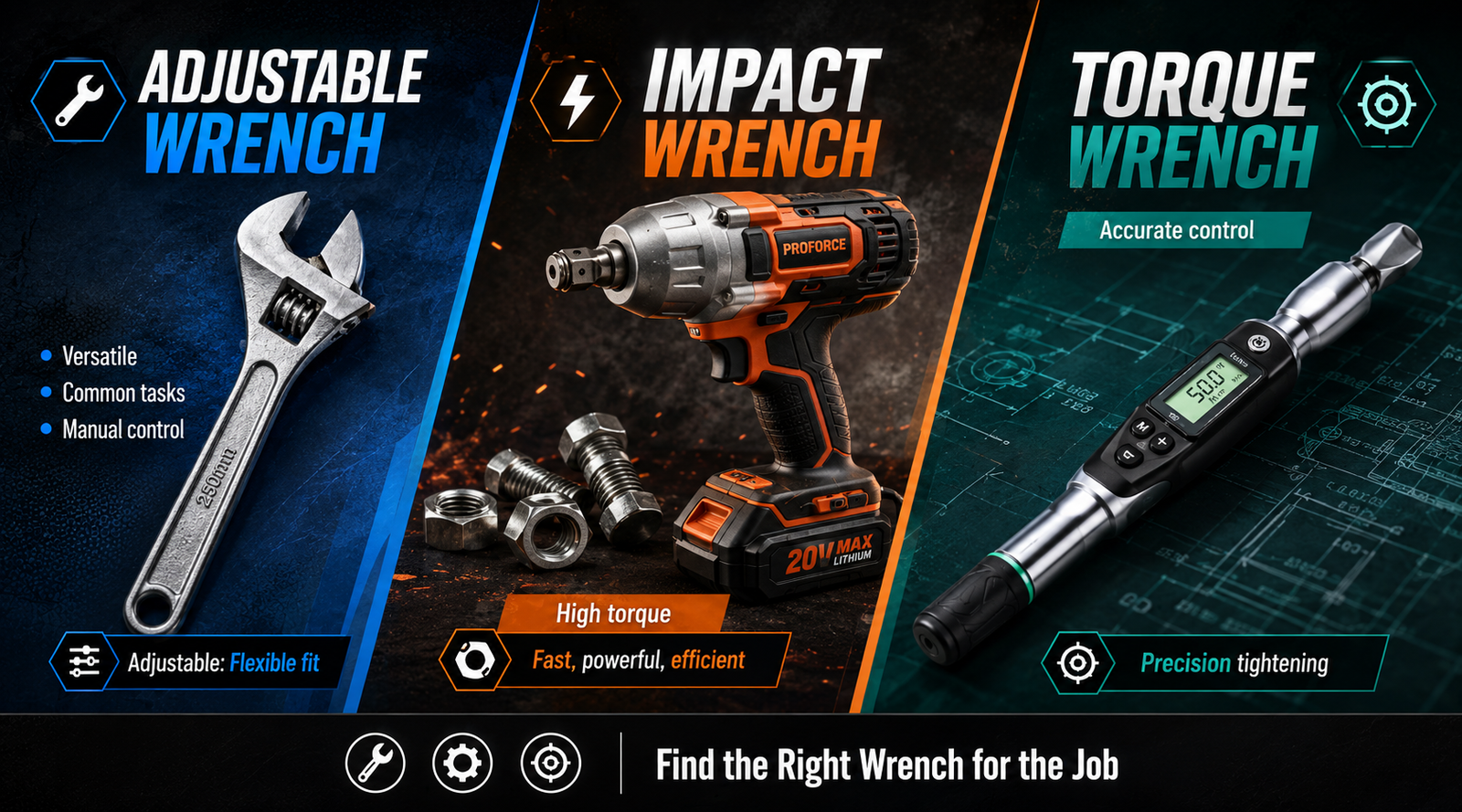
If you have ever stood in front of a toolbox thinking, “Which wrench do I actually need for this job?”, you are not alone. The Adjustable wrench, impact wrench, and torque wrench may look like they live in the same family, but they solve very different problems. One is built for quick fitment across multiple nut sizes, one is built for speed and power, and one is built for accuracy and controlled tightening. In this guide, we will break down what each tool does best, where people go wrong, and how to choose the right one, especially if you are sourcing for workshops, factories, or export markets from an Adjustable wrench exporter, impact wrench suppliers, or a torque wrench manufacturer.
Quick Summary (For Fast Readers)
- Use an Adjustable wrench for quick grip on different nut sizes when you want flexibility.
- Use an impact wrench for fast removal or tightening of stubborn fasteners, especially in automotive and heavy-duty work.
- Use a torque wrench when the final tightening must be accurate and consistent.
- An impact wrench is great for speed, but it should not be your final tightening tool for critical jobs.
- A torque wrench prevents over-tightening and under-tightening, which protects threads and avoids failures.
- For bulk buying, confirm build quality, material, torque accuracy (for torque wrench), and packaging specs with your impact importer requirements in mind.
What Is an Adjustable Wrench and When Should You Use It?
An Adjustable wrench (often called an adjustable spanner) has a movable jaw that lets you fit different nut and bolt sizes. It is the classic “one tool fits many” option, which makes it popular for maintenance work, plumbing, light fabrication, and field jobs where carrying a full set is not practical.
Best Uses of an Adjustable Wrench
- Plumbing fittings and unions
- General maintenance jobs
- Light mechanical work
- On-site repairs where nut sizes vary
- Quick adjustments on non-critical fasteners
Strengths
- Flexible size range: one tool covers multiple fastener sizes
- Convenient for technicians who want fewer tools
- Good for low-to-medium torque tasks
Limitations (Important)
- It can slip if not positioned correctly
- It can round off nuts if the jaw is loose or angled
- It is not ideal for high-torque or repetitive production tightening
Pro tip: Always apply force on the fixed jaw side and keep the jaw snug. A loose Adjustable wrench is the fastest way to damage a nut.
Sourcing Note for Bulk Buyers
If you are working with an Adjustable wrench exporter, ask about:
- Material grade and heat treatment process
- Jaw hardness and jaw play tolerance
- Corrosion resistance (chrome finish, anti-rust coating)
- Consistency of jaw movement across batches
What Is an Impact Wrench and Where Does It Fit?
An impact wrench is a power tool designed to deliver high torque in short bursts. Instead of you applying steady force like a hand wrench, it uses a hammering mechanism internally. That is why it can loosen rusted bolts, wheel nuts, and heavy fasteners quickly.
Impact wrenches are common in:
- Tyre shops and automotive garages
- Heavy equipment maintenance
- Industrial assembly lines (where speed matters)
- Construction and fabrication workshops
Best Uses of an Impact Wrench
- Removing wheel nuts and lug bolts
- Loosening seized bolts
- Fast repetitive fastening work
- Heavy-duty maintenance tasks
Types (Quick Breakdown)
- Cordless impact wrench: portable, great for field work
- Corded impact wrench: steady power, good for workshops
- Pneumatic impact wrench: very common in garages with air compressors
Strengths
- Saves time on repetitive jobs
- Handles tough, stuck fasteners
- High torque output with less manual effort
Limitations (Don’t Ignore This)
An impact wrench is not a precision tool. It can easily over-tighten and damage threads if you rely on it for final tightening. That is why many professionals use an impact wrench for speed and then switch to a torque wrench for accuracy.
Sourcing Note for Importers
If you are an impact importer or buying from impact wrench suppliers, confirm:
- Rated torque range and real-world performance
- Spare parts availability and service support
- Warranty terms for bulk orders
- Packaging strength for export and transit damage reduction
- Compliance and documentation relevant to your market (without over-claiming)
What Is a Torque Wrench and Why Accuracy Matters?
A torque wrench is designed for controlled tightening to a specific torque value. Instead of guessing “tight enough,” you set the torque and tighten until the tool signals you (click, digital beep, or visual indication depending on type). This is critical when a fastener must be tightened within a safe range.
Common applications:
- Vehicle wheel nuts (final torque)
- Engine and suspension components
- Industrial machines and assembly
- Equipment installation and maintenance
- Any job where safety and warranty depend on correct torque
Why Torque Accuracy Is a Big Deal
Under-tightening can cause fasteners to loosen due to vibration. Over-tightening can strip threads, crack components, or deform parts. A torque wrench protects both the fastener and the assembly.
Types of Torque Wrench (Simple)
- Click type torque wrench: most common, easy to use
- Beam type torque wrench: simple and durable, visual reading
- Digital torque wrench: advanced features, easier reading
Calibration and Control
A torque wrench should be calibrated periodically, especially for professional use. If you are buying from a torque wrench manufacturer, ask what calibration method is used and whether they can provide torque accuracy documentation for your market.
Comparison Table: Adjustable vs Impact vs Torque Wrench
| Feature | Adjustable Wrench | Impact Wrench | Torque Wrench |
| Main purpose | Flexibility across sizes | Speed + high torque bursts | Accurate tightening |
| Best for | Maintenance, plumbing, general repairs | Automotive, heavy-duty loosening/tightening | Final tightening, safety-critical work |
| Key advantage | One tool fits many fasteners | Fast, powerful, reduces effort | Prevents over/under-tightening |
| Biggest limitation | Can slip/round nuts at high force | Not accurate for final torque | Needs calibration and correct use |
| Typical user | Technicians, installers | Workshops, tyre shops, industrial maintenance | Mechanics, assembly teams, quality-controlled operations |
How to Choose the Right Wrench (Decision Guide)
1) Choose Based on the Job Type
- Plumbing / general maintenance: Start with an Adjustable wrench.
- Fast removal, stuck bolts, wheel nuts: Use an impact wrench.
- Final tightening with exact specs: Use a torque wrench.
If you are doing automotive work, the most practical combination is:
- Impact wrench to remove and run nuts down quickly
- Torque wrench to tighten to final specification
2) Choose Based on Risk and Precision
If failure could cause damage, safety issues, or warranty rejection, a torque wrench is not optional. It is the correct tool.
3) Choose Based on Frequency of Use
- Occasional use: a good-quality Adjustable wrench plus basic torque wrench coverage can work.
- Daily workshop use: invest in strong tools, consistent batches, and service support from impact wrench suppliers and a reliable torque wrench manufacturer.
4) Choose Based on Your Buyer Profile
If you are an impact importer sourcing for trade customers, stock fast-moving ranges:
- Popular impact wrench models (by drive size and torque class)
- Torque wrench ranges commonly used in automotive and industrial service
- Adjustable wrench sizes that cover the most common fastener ranges
What Importers & Bulk Buyers Should Check Before Ordering
Whether you are dealing with an Adjustable wrench exporter, impact wrench suppliers, or a torque wrench manufacturer, bulk procurement should be treated like a quality project, not a one-time purchase.
Adjustable Wrench Bulk Checklist
- Jaw strength and jaw play tolerance
- Smooth adjustment mechanism
- Surface finishing and rust resistance
- Consistency of markings (size scale, branding, batch coding)
Impact Wrench Bulk Checklist
- Verified torque performance (not just marketing numbers)
- Tool durability under continuous use
- Battery platform and backup battery availability (for cordless)
- After-sales support and replacement parts
- Export packaging and drop-test style protection
Torque Wrench Bulk Checklist
- Torque accuracy and repeatability
- Clear scale and easy setting mechanism
- Calibration guidance and service availability
- Protective case and storage method (torque tools must be stored properly)
Common Mistakes to Avoid
- Using an impact wrench for final tightening
Great for speed, risky for precision. Final tighten with a torque wrench. - Keeping the Adjustable wrench slightly loose
This causes slipping and rounded nuts. Tight jaw, correct direction, steady pressure. - Using regular sockets with an impact wrench
Impact-rated sockets are designed for impact loads. Wrong sockets can crack. - Never checking or calibrating a torque wrench
If accuracy matters, calibration matters too. - Buying bulk without checking batch consistency
A sample can be perfect, but bulk can vary. Insist on quality checks and consistency.
FAQs
1) Can an impact wrench replace a torque wrench?
No. An impact wrench is mainly for speed and high torque bursts, while a torque wrench is for accurate final tightening.
2) Do I really need a torque wrench for wheel nuts?
For professional work, yes. Wheel nuts should be tightened to the correct torque to avoid loosening or over-tightening damage.
3) When is an Adjustable wrench the best choice?
When you need flexibility across sizes, especially for maintenance and plumbing tasks where carrying multiple spanners is inconvenient.
4) What should an impact importer ask suppliers before ordering?
Ask about real torque output, durability testing, warranty terms, spare parts support, and export packaging. Reliable impact wrench suppliers should be transparent on these points.
5) How often should a torque wrench be calibrated?
It depends on usage frequency. Workshops typically follow periodic calibration schedules, and heavy use may require more frequent checks.
6) Which is best for industrial assembly work?
Many assembly lines use an impact wrench for speed but rely on a torque wrench (or controlled torque tools) for final tightening where precision is required.
7) What matters most when choosing a torque wrench manufacturer?
Consistency, accuracy, calibration support, and clear documentation for your target market. A trustworthy torque wrench manufacturer will prioritize repeatable quality.
8) Can an Adjustable wrench handle heavy-duty bolts?
It can, but it is not ideal. For high torque tasks, fixed-size spanners or sockets often provide better grip and safety.
Conclusion
The right wrench depends on what you are trying to achieve: flexibility, speed, or accuracy. An Adjustable wrench is your practical all-rounder for varied sizes and general maintenance. An impact wrench is your time-saver for stubborn or repetitive fastening jobs. A torque wrench is your accuracy tool for correct final tightening and safety-critical work. For bulk buyers and trade customers, the best approach is to stock all three categories and source carefully from a proven Adjustable wrench exporter, reliable impact wrench suppliers, and a consistent torque wrench manufacturer that supports quality, documentation, and repeatable batches.
Читайте также: Почему российские покупатели и импортеры ручного инструмента все чаще выбирают индийских производителей